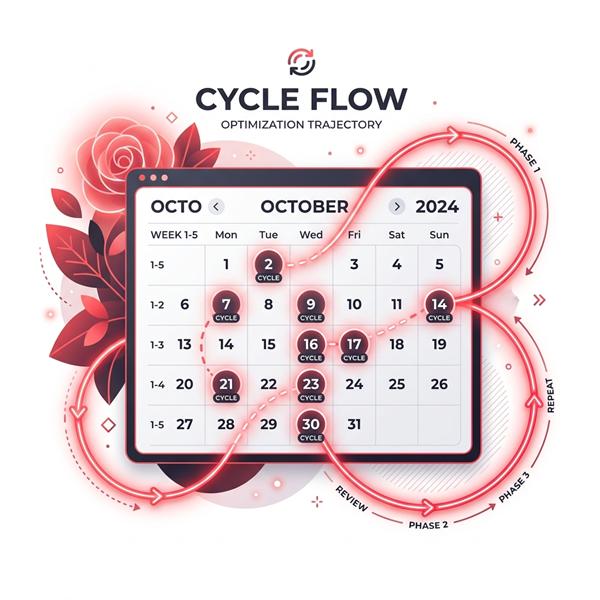
Menstrual cycles are a fundamental biomarker of reproductive health and digital wellness. Tracking your biological rhythm helps you anticipate cycle changes, identify health fluctuations, and map out fertility windows. By employing a dedicated period cycle calculator or ovulation calendar, you bypass manual calculations and access immediate, privacy-focused biological assessments. Let us explore the science and mathematics governing menstrual cycle tracking.
The Four Biological Phases of the Menstrual Cycle
A standard menstrual cycle is measured from the first day of menstrual bleeding (Day 1) to the day before the next period starts. While 28 days is the textbook average, normal cycle lengths for healthy adult women range between 21 and 35 days. The cycle is divided into four main biological phases:
- Menstrual Phase (Days 1–5): The shedding of the endometrial lining of the uterus, visible as vaginal bleeding. Estrogen and progesterone levels are at their lowest during this phase.
- Follicular Phase (Days 1–13): Overlapping with menstruation, the pituitary gland releases Follicle-Stimulating Hormone (FSH). This hormone stimulates the ovaries to grow several fluid-filled sacs (follicles), each containing an egg. As follicles mature, they release estrogen, which rebuilds the uterine lining.
- Ovulatory Phase (Day 14): High estrogen levels trigger a sharp surge in Luteinizing Hormone (LH). This surge causes the dominant follicle to rupture and release its mature egg into the fallopian tube. This is the process of ovulation, which represents the peak fertility window.
- Luteal Phase (Days 15–28): The ruptured follicle transforms into the corpus luteum, which secretes progesterone. Progesterone thickens the uterine lining to prepare it for a fertilized egg. If fertilization does not occur, the corpus luteum degenerates, hormone levels drop, and the cycle resets with a new period.
The Mathematics of Cycle Predictions
Online period tracking tools use mathematical formulas to forecast future cycles:
- Period Start Date Calculation: The next period date is projected by adding your average cycle length (in days) to the first day of your last period.
Next Period Date = Last Period Start Date + Cycle Length - Ovulation Day Prediction: Biologically, the luteal phase remains relatively constant at 14 days. Therefore, the ovulation day is calculated by subtracting 14 days from the estimated next period date.
Ovulation Date = Next Period Date - 14 Days - Fertile Window Mapping: Because sperm can survive inside the female reproductive tract for up to 5 days, and the egg lives for 12 to 24 hours after release, the fertile window is calculated as the 5 days leading up to ovulation plus the day of ovulation itself. This 6-day window represents peak fertility.
Understanding Cycle Irregularities
Very few individuals experience a perfect 28-day cycle every month. Cycle lengths can fluctuate due to sleep changes, dietary adjustments, travel, stress levels, or underlying conditions (like PCOS or thyroid issues).
When using an online menstrual cycle tracker, it is highly recommended to input average cycle lengths calculated over a 3- to 6-month period rather than relying on a single month's index. This averages out deviations, offering more realistic forecasts.
Why Use a Privacy-First Online Period Calculator?
In the digital age, reproductive data privacy is more critical than ever. Many standard period-tracking mobile apps store entries on external servers. Our local period cycle calculator solves this by keeping your calculations 100% private:
- No Server Logs: Your last period date and cycle lengths are processed entirely client-side. The website has no database connection, ensuring that your health data never leaves your device.
- 3-Month Interactive Calendar: The tool generates a color-coded 3-month calendar overlay, highlighting estimated period days, peak ovulation days, and fertile windows at a glance.
- Safe Days Tracker: Helps you identify lower-risk days using standard calendar calculations. Note: While useful for wellness tracking, standard calendar methods should not replace medical advice or contraception.
Frequently Asked Questions (FAQ)
The calculator subtracts 14 days from your projected next period start date. This is because the post-ovulatory (luteal) phase is biologically stable at 14 days for most individuals, regardless of overall cycle length.
The fertile window spans 6 days: the 5 days prior to ovulation and the day of ovulation itself. This accounts for the 5-day lifespan of sperm and the 24-hour lifespan of the released egg.
No. We operate a zero-log, privacy-first platform. All calculations are executed locally inside your browser window using client-side JavaScript. No inputs are sent to remote databases.
Conclusion
Tracking your period cycle provides deep insights into your body's health rhythms. Try our client-side, ad-free Period Cycle Calculator to map your upcoming cycles, ovulation days, and fertile windows securely.